Sunday, January 9, 2011

Looking Back to Look Forward

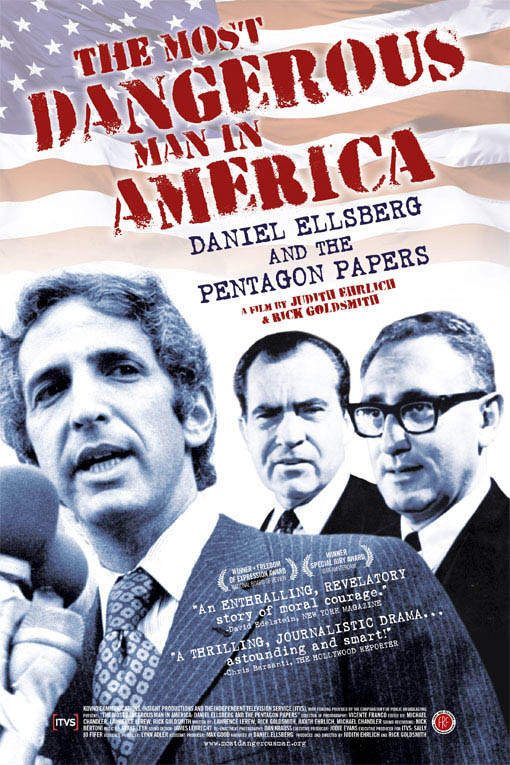
Currently, like as I type, I am watching the film The Most Dangerous Man in America: Daniel Ellsberg and the Pentagon Papers. It is engrossing and disturbing and illuminating. To understand the past you have to have a relatively trusty barometer of the present. Turn this around and it is equally true. Daniel Ellsberg with his release of the Pentagon Papers illustrates the incredible importance of governmental leaks. It is proof of the enduring moral spirit of humanity. We are not yet robots, though it seems more and more that this is the goal. The government -- as it is, as it was, as it will continue to be -- functions as a business does and would benefit greatly from the demoralization of those in their employ and those which would be in the position to point the big finger (namely the media). We, as thinking and feeling humans with a sense of right and wrong, should be proud, existentially, of those who leak. This should never be criminalized.

The Pentagon Papers was a top-secret study on the history of U.S.-Vietnamese relations, prepared by the Department of Defense. It was commissioned by then Secretary of Defense Robert McNamara, seemingly in order to understand why it was that, opposite all public knowledge, things were going badly in Vietnam. The study was operated without the knowledge of President Lyndon Johnson or Secretary of State Dean Rusk. Daniel Ellsberg photocopied the 7,000 pages and in the middle of 1971 the New York Times began to publish. This was swiftly met by resistance on the part of the Nixon administration, who had continued the failing war despite his campaign pledges to find a way to end it. Many Nixon tapes are evidence of his extreme anger at the release, with conversations between the foul-mouthed president and Henry Kissinger (who had dubbed Ellsberg at the time, "the most dangerous man in America") or Alexander Haig. The government went to work prohibiting the papers from printing and Daniel Ellsberg being indicted under the Espionage Act of 1917. A precedent was set when the Supreme Court ruled that the leak and its publication were not illegal in the case of The United States vs. Daniel Ellsberg and Anthony Russo (Russo being his fellow RAND employee, researcher and accomplice). Papers resumed publication and Ellsberg and Russo were freed from their possible 30 and 115 year stay in prison, respectively.

There are many facets of this historical event that could be discussed which I won't here. The leak, among many other things, illustrated that the U.S. was involved in a wrongful war for reasons divergent from their public statements and that these lies spread across three decades, being spewed from the mouths of five presidents (Truman, Eisenhower, Kennedy, Johnson and Nixon). Not even America's fallen golden boy, Kennedy, could be trusted on this front. That, in itself, should give pause to anyone who overly praises and trusts any politician or leader. This country was built on the idea of a questioning citizenry and that shouldn't be given over under any circumstance. The Supreme Court at that time set an important precedent for the exercise of the First Amendment. Yes, that one about free speech.

Now, 40 years later, that precedent must be respected. Wikileaks are in the frying pan now, just as was Ellsberg at that time. The U.S. government is as rabid as it was then, although they muffle it publicly just the same. They are again attempting to massage the Espionage Act into this issue. Beware. Our right to know and a leaker's right to bravely exercise his/her morality should be protected absolutely. The releases of the current leak, that of the diplomatic cables, are not being controlled by Wikileaks (i.e. redactions and editing) but rather by the publications they gave the responsibility. This is exactly the same as any type of leak, just on a much grander scale. Although many so-called "journalists" (a great deal of whom are from the American media and whose overlords gleefully collude with massive corporations and government) are happy to through Assange and Wikileaks under the bus on this, it says more about those journalists than it does about Wikileaks.

I have to say, repeat, that this is important, so very important. We can't lose our morals and ethics to programmed autonomy or ambivalence. We need to support, as Ellsberg himself is now doing, the actions of organizations like Wikileaks and all the others that are beginning to pop up. Truth is a worthy goal.

So, watch the movie. Get a perspective. Don't get your news from a single source. Shop around. Assume everyone is biased and figure it out yourself. And, your politicians are most likely lying to you.
Friday, January 7, 2011

An Unfortunate Journey

I am beginning a trial-run of a gluten-free diet today, to resume for three months' time. I am not very energetic about this. Nor do I enjoy the amount of research it is taking to do it right. If it is that I have Celiac's (which given my Irish and German roots, is a good genetic possibility) then, I am told, even a thimble-full of something containing that special protein would set me back 6-8 weeks. It is a sparse possibility in my case that I do have this, but a possibility all the same. I won't see a change for at least 4 to 8 weeks apparently, if there is no accidental hiccups in my ingestion schedule. Damnit.

If anyone has any tips, give them to me. I want them. I love bread and beer and they can't have me for at least three months. I am looking towards sake and wine for respite. Maybe brown rice pasta, corn and potato chips and corn tortillas. That's all I got for now. Thanks for your ear.

Thursday, January 6, 2011

Seattle's Got A Superhero!

Up in the Northwest, along with the comic book nerds comes heroic vigilantism. I love it.


Yep.

Sunday, December 26, 2010

That Button Just Makes You Feel Better

Ever wonder why the elevator doors don't close right away when you push that "Close Door" button? Because it does nothing. Here is a great post about this and other non-functioning buttons in your life:

http://youarenotsosmart.com/2010/02/10/placebo-buttons/

Enjoy!

Sunday, December 19, 2010

Shifting Educational Paradigms or Are Our Kids Learned Much?

So, Western education. How is that going for us? Well, the U.S. consistently falls way behind in tests given internationally. And, generally, many parents must rely on expensive private schooling. That shouldn't be. Maybe, instead of enacting legislation that assumes all kids are the same and patting oneself on the back for that crippling maneuver, we should change the way in which we teach. Maybe we should spend less on war and more on arts and education. I know, it sounds crazy. Check out this video. It is not only entertaining but informative.


Feel free to leave comments.

Sunday, December 12, 2010

Writing 50,000 Words in a Month

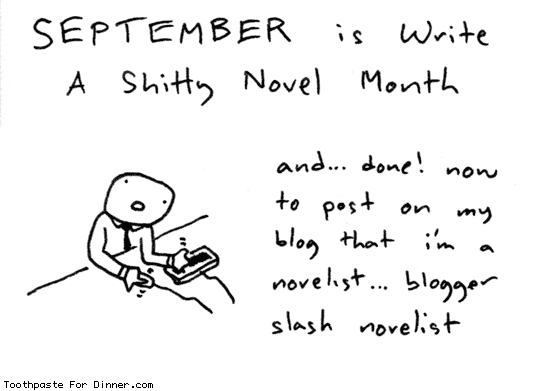
So, for the month of November, I wrote. I wrote a lot. I wrote about 55,000 words in total. The event was the National Novel Writing Month, or for those in the know, NaNoWriMo. 50,000 words in a month (30 days) equals out to about 1,667 words a day on average. This means about an hour to two a day for a month. I must say, it was difficult. At first. But, after doing it for awhile and foregoing social events, I felt inspired by my own abilities and I wrote with relish most days following the initial ten or so. This was what I was engaged in while I was leaving this blog to disuse. So, now I have spent the day logging posts for the possible enjoyment of my small crowd. The novel in question is a ramshackle affair whose parts may be stronger than its whole. A rubric of ideas from which I may pull, if you will. I will share a small section and cease my bloggish rambling.

"The bus was an experience which truly showed the heart of the city and which varied depending on the part of the city the bus was in. In this section, the University District to Ballard, it tended to be quiet weirdos, loud weirdos, totally middle of the road new generation business men (who read the Seattle Times and tried not to look uncomfortable in their suits), or students. His experience on the bus was mostly one of scholarship, or rather he would read vigorously, shutting out the world around him and occasionally peeking his head out of the words to check his location. To be able to read on a moving vehicle, he had had to train himself, tune certain parts of his brain into not reacting to the movement of the bus and rather focusing on the movement of the eyes across the landscape of words. He was very pleased with himself whenever he thought of it. The bus allowed certain opportunities such as this which were not an option on the bike. This made him feel less guilty about leaving his spry little bike hiding in the bike room, gathering dust. He read and sometimes wrote. When he wrote he would look out in front of him into the infinite cave of thought, or observe his neighbors for inspiration. At this moment, on this day of his riding, just in front of him, in the seat before him, were two young men, students it seemed, who thought everything was funny and whose laughs were an awkward ordeal that couldn’t hide their own uncomfortableness with their own man bodies and man voices and man to man relationships.
One of the two man-boys was a small giant with knobby sausage fingers, whose nails looked like small square plates pushed deep into putty. These fingers were the outlet of his insecurities and his uncomfortableness. He grabbed the purple plastic handle on the seat in front of him like he was grabbing the ears of a small child, big putty hands on each side of the thing, and he began to thumb at the middle for no reason at all, his oily thumb tips massaging the hard plastic. He would do this and also use his thumb-looking fore fingers to roughly stroke the thing with outward motions. The third and grossest of the activities with this poor plastic handle was a right handed twisting and stroking, some unconscious masturbatory gesture he hadn’t yet excelled from expressing. Henry’s face twisted up in disgust. This was not the morning image that he wanted. He couldn’t stop watching though. The man-boy couldn’t stop molesting the thing either, like there was still some un-oiled surfaces he had to cover with the sick ritualistic gestures of a pastor with his altar boy. Henry began to express his feelings of disgust on the page, describing the display very much similarly as this narrator has done above, his script jarred often by the bumps.
When he was reading on the bus, he always got the feeling like something was going on that he needed to see, some scenery or event, something he couldn’t see just anytime. He could have gone without the man-boy event. But, when he was not reading, just staring, and nothing happened, as it was apt to, he felt as though he should be productive and read. He couldn’t win, even with himself. There were always at least two books to read, and two notebooks in which to write. Besides that he kept a camera. He liked to take pictures and didn’t care if they turned out to be anything or spent an eternity catching byte dust on his computer. The act itself was enjoyable. He knew nothing about framing, technically, or really what many of the settings did. He just took the pictures how he thought they looked good. It wasn’t an analogue for experience though as it is for many these days, the Asian tourists and the Hipsters in particular. He felt that they never actually lived life but rather made proof of a life lived. They weren’t there for any of it, personally, just their human forms. There were all the Asian tourists with their factory smiles giving the V for Victory sign with their hands in every single shot, waiting until they could get home and put it on their social networking site. The Hipsters as well just made evidence of life in order for it to be posted online, going further though into that sickly realm of irony. The ironic mustaches and poses, the ironic mimicry of Asian tourists even possibly, creating some facsimile of reality that seemed labyrinthine and inescapable."

I must say that I have done no editing and would be so very fine with anyone telling me if something sounded weird or was just outright wrong. It is very possible that both things have occurred, possibly simultaneously. Anyway, that's all I got. Plus this cartoon which identifies my situation near perfectly:

That Whole Wikileaks Thing...

So, unless you are a cave-dweller (in which case you wouldn't be reading this right now), you know about Julian Assange and his secretive assemblage of super-hackers. In the last few months, several thousands of documents have been released, some of which have shown the public things they assumed but didn't have proof of directly (like say, from the horse's very own mouth where the horse is the government or the Pentagon). People have been stunned and appalled by the relish with which innocent people were mown down with helicopter super-machine guns (whose bullets are made to pierce tank armor). Yes, we all know that war is hell, but we all hope that the mindset which made the Third Reich possible wouldn't seep so easily into the skulls of our supposed protectors. From "Collateral Murder" to the more recent slow dissemination of diplomatic cables, Wikileaks has made a name for itself.

Ridiculous calls to action by certain entertainers/politicians, calling Assange a traitor (which he isn't, obviously, not being a U.S. citizen or acting within the U.S.), a terrorist (again silly and ignorant), and targeting him for assassination, show that this has stirred some pots and some people are scared about the implications (not to the structure of foreign relations, I'll say, but to their own exposition possibly). Wikileaks has so far put out more leaked documents than have all the news organizations combined over the years. This is significant. That the current leaks, the cables, haven't turned out to be shocking or game-changers exactly, doesn't mean that they don't have huge implications to not only government transparency but also the meaning of free speech and the function of an increasingly impotent journalism. These leaks reveal something of all shades of government, throughout the whole world, no matter what ideology is at work. Therefore this has the amazing ability to surpass political identity within the public and let them see exactly in what their representative government has been engaged, be it bad or good.

Already, those who didn't agree with the secrecy of the transparency-obsessed Wikileaks have split off to create Openleaks, which will launch tomorrow. The basis of this more transparent organization would be to act as a protected go-between for leakers and publications, where they themselves publish nothing at all. This is a good thing. And this is not to say that I don't agree with the secretive workings of Wikileaks, but it means that the ideas are finding footing in which to evolve this beneficial process of stopping illegalities on the governmental level. Julian Assange, the media doll, has added mystery-novel flourishes to the story with the news of his insurance file (his "poison pill"), a 256-bit encrypted file (called "nearly impossible to crack" by a major cyber security expert) which includes 1.4 gigabytes of leaked material which may include information leaked from Bank of America and BP and the convenience of the Interpol warrant's timing on spurious charges. The key to the encryption lies with him and will be released to the thousands who have downloaded the archived file from the site in the event of his indictment or murder. That is, I have to say, pretty cool. Since his arrest, so called "hacktivists" have attacked the sites of Amazon, PayPal, Mastercard and Visa for pulling their services from Wikileaks. It looks like an effort by a small and mobilized group representing goals antithetical to the overly secretive governments. This I can applaud, no matter how little it will really affect those companies' abilities to make money.

What does it mean? What will happen in the long run? How will this affect the happenings in the worlds of government and journalism? This is not yet apparent. But, at the least, Wikileaks has garnered a response by the U.S. government and its allies which shows their disregard for transparency and how easily they can slip into tyrannical muscle flexing. Whatever happens, it will be something to watch.

Here are some articles and websites of note:

Beet Kvass and Other Fermented Goodness

 About two weeks ago, I started something called beet kvass (it is the jar in the picture which looks like it has beets in it). The beets came into the kvass picture later in the game, as kvass was a fermented drink birthed out of Eastern Europe and Russia using mainly rye bread and water, with various other spices and fruits used as well. The point of the bread was that it had live cultures in it, like say, sourdough does. When soaked and left to ferment, those cultures are awakened and thrive. It was something often drank by the peasants after long days of work, as it was extremely nutritious and had a small amount of incidental alcohol. Lucky for them. Beet kvass uses a similar idea. It can include bread but many now prefer to use whey (as in the liquid stuff which pools in your container of yogurt). I myself, already steeped in a great deal of fermentation projects, have used just a couple tablespoons of the juice from one of my other pickles as starter. It needs a starter to begin its wonderful process.

Now to start this process I had to chop up the beets coarsely (after the strenuous act of peeling them), as you can see in the picture, and put them in my clean jar. This is three good sized beets, like softballs. It is ill-advised to shred the beets, as every site has warned me, since the beets then let off too much juice at once, sugar as well, and it turns into something more alcoholic. Not to say that it wouldn't be good, I just don't know. If anyone tries that method, let me know how it goes. So the beets are cut and in the jar, good. Now I add one tablespoon of salt and one or two tablespoons of starter (this can be your pooled liquid from yogurt or raw milk, or like me, some sauerkraut or pickle juice lounging around the fridge). You want to have spring water, void of that anti-bacterial chlorine which will destroy our wonderful bodily allies, and fill it up to about one inch from the top. My jar is two quarts. This space between the water and the top is where the excess CO2 created from fermentation will go. If you are using a mason jar, you might keep the lid just a little shy of tight, so as to allow for the escape of the CO2. With my clamp jar I haven't had any issues but do open it each day to release any pressure it builds. Wouldn't want a hole in my jar.

Beets are an extremely healthy vegetable, with implications for use in prevention and healing of cancers, the lowering of blood pressure, the increase of blood flow to brain, alkalization of blood, etc etc etc. It has many vitamins and minerals as well as antioxidants and other compounds of great benefit. Go here to see all the numerous benefits of this gorgeous vegetable. The fermentation of this concoction further increases the nutritional benefit, with the addition of probiotics which not only benefit digestion but help process the nutrients within for greater absorption. The tonic becomes red with time. It needs only three or so days outside of the fridge to be considered ready. The taste is salty and earthy sweet, like you are sucking down the very soul of the beet. If the taste is too salty, then the next batch should be prepared with that in mind, decreasing the salt to your taste. When the first batch is downed, the beets within can be given one more go, a little bit diluted from the first but still extremely beneficial and thirst-quenching.


The picture above includes the second chapter of my beet kvass (on the left, with golden beets this time), my newly fermented sauerkraut (middle, with the addition of organic Gala apples this time for sweetness) and a compendium of various vegetables set to ferment in a mason jar (right, the scraps of the moment are carrots, turnips, celery, brussel sprouts, red pepper and ginger). The last one is an ongoing experiment, which I pull from randomly and drop extra vegetables into. Fermentation is ridiculously easy, one just has to try it out. And let me know about it. Here are a few links to help you along:

I hope that this starts some on a fermentation frenzy. I can vouch for its enjoyment.

Tuesday, October 26, 2010

Cool Video Amongst Many

Here is a cool video of Yeasayer, a capella in the subway:


#87.1 - YEASAYER - No need to worry / Redcave
Uploaded by lablogotheque. - Watch more music videos, in HD!

The website is called La Blogotheque, some French concoction, and it has videos of various great bands making music out in the open, say the street or someone's house, the subway or a backyard. Something like that. You should check it out.

Friday, October 15, 2010

Everyone Should Be So Happy

My favorite video of right now.


Yessssssss.

Though You May Have Seen It...

Here is what a so-called "Happy Meal" looks like after 180 days:


Just search for "happy meal" on the Google and you will get the story, which is essentially the same as this picture, but with rabble.

Sunday, October 10, 2010

Ways in Which One Can Make Food

As a follow-up to my previous post about the pathetic state of American eating, a state which could be helped immensely by the actuating of those common sensibilities built (though sometimes hidden deep within an overlarge shell) into each person with thoughts, I figured I would put up some recipes that represent vegetables as a main event. We are just coming into Autumn and as such many of the recipes are attuned to that season's fare. Each week, with our produce box, we get a sheet of recipes which more often than not has saliva-producing effects. The following are four such sheets.


 Each image can be clicked to enlarge and printed out. I would love it if someone made one of these recipes and commented (just below the post) with the results. Enjoy eating healthy.


Tuesday, October 5, 2010

Eating and Sleeping...

I have recently been looking at the New York Times' most popular health-related articles while vegging out before my computer. I find it funny and strange that there are so many fad diets and "miracle" pills when eating normally can be so easy. OK, normal nowadays is a relative term. Many Americans, most Americans, have a particular difficulty with looking back into their own cultural ancestral history and seeing what normal food eating looks like. Normal should be common sense but it no longer is. Common sense and normality have been violently blurred by modern day marketing, that apparatus of total deception. Processed food has taken the average American and run their entire system (beginning with digestive and continuing on to the cardiovascular, nervous, lymphatic, endocrine, muscular, skeletal and reproductive) through the proverbial mud. Flavorists can control taste and smell, fooling the mind into thinking that McDonald's fries (which never decompose) or Burger King's patties (guaranteed to be part feces) are good. They are not good. You are being fooled.

The common sense part: eat vegetables and fruits, walk around, sleep right. Meat, although extremely popular, is not the end-all be-all of food. It isn't very good for you. Eat some fish. Eating bad fats makes you fat. Period. Stop it already.

Here are those aforementioned New York Times articles:

So, eat right and get some sleep already!
 

    Everyone Should Read Banned Books!

    In Springfield, MO, Kurt Vonnegut Jr.'s Slaughterhouse Five was recently pulled from high school curricula because of the opinion of one man. This man is a professor at Missouri State University, my alma mater. He is part of education, ladies and gentlemen. Scary. He believes it is "filthy," the book that is. As well as others. Here is the link to the story in Springfield's "newspaper." And here is a good analysis of the action. The following is from the Vonnegut book in question. Beautiful, smart, peaceful. And apparently part of a larger more evil and pornographic work, if you want to believe a guy named Scroggins.

    "The formation flew backwards over a German city that was in flames. The bombers opened their bomb bay doors, exerted a miraculous magnetism which shrunk the fires, gathered them into cylindrical steel containers, and lifted the containers into the bellies of the planes. The containers were stored nearly in racks. The Germans below had miraculous devices of their own, which were long steel tubes. They used them to suck more fragments from the crewmen and planes. But there were still a few wounded Americans, though, and some of the bombers were in bad repair. Over France, though, German fighters came up again, made everything and everybody as good as new.

    When the bombers got back to their base, the steel cylinders were taken from the rack and shipped back to the United States, where factories were operating night and day, dismantling the cylinders, separating the dangerous content into minerals. Touchingly, it was mainly women who did this work. The minerals were then shipped to specialists in remote areas. It was their business to put them into the ground, to hide them cleverly, so they would never hurt anyone ever again.

    The American fliers turned in their uniforms, became high school kids. And Hitler turned into a baby, Billy Pilgrim supposed. That wasn't in the movie. Billy was extrapolating. Everybody turned into a baby, and all humanity, without exception, conspired biologically to produce two perfect people named Adam and Eve, he supposed."


    Sunday, September 26, 2010

    Read GO SEE ART Post!

    I just posted on the GO SEE ART blog about Banned Books Week. Go read it!

    Here is the poster for it, with robots!

    Wednesday, September 15, 2010

    A Day in the (Work) Life

    Although this was created before my employ at Espresso Supply, the following video shows what happens on a daily basis at work in the shipping department. Enjoy it.


    Also, if you have any need for coffee making things, here is the site: http://www.espressosupply.com/

    Sunday, September 12, 2010

    Bike to Wineries, Check.

    Yesterday (Saturday, the 11th), we biked to the wineries. Myself, Anne and our friend Zack. This was an event that we had been wanting to do for some time and only ended up doing as a result of our panic that Summer was in its death throes. The ride was about 18 miles there, but we got off the trail too early and added nearly five more to that. The Burke-Gilman Trail runs through Seattle, beginning at 11th street in Ballard and ending above the Northern finger of Lake Washington at Bothell. From there it is replaced by the Sammamish River Trail, which continues to the wineries accompanied by the Sammamish River, whose banks are crowded with small bungalows and scrappy boats. Both trails are rail trails, conversions of unused railroads, which make for very evenly graded paths.


    It was a gorgeous day, luckily for us. The ride was relaxing and surprisingly easy. We rode into our usual winery destinations, starting at Columbia Winery. I am a member there, thanks to my mother, and enjoy two free tastings for four people each time I go. We were joined, via her car, by Zack's girlfriend, Jamie.


    We brought various farmer's market fare to eat. A baguette filled with olive oil, basil and garlic. A creamy spreadable fromage with truffle salt in it. Some fontina cheese. Plums, various berries, heirloom tomatoes and lentil sprouts. It was decadent and delicious. We got our tastings at Columbia, our heads humming with wine, then we headed across the street to Chateau Ste. Michelle.


    Anne walks with determination near the plants of her Spanish ancestry. Here, at Ste. Michelle, the grounds are much more exciting and decorative. They even have a stage for the big name bands of yesteryear to play such as Crowded House; Steely Dan; Earth, Wind and Fire and Chris Isaak to name a few. And they have fowl. Ducks, geese and peacocks. The vines on the property are decorative only, as the real grapes are grown in more sandy, loamy soil on the other side of the Cascade Mountains. As such, these grapes are a little sour...


    ... as can be seen in the above picture, in Jamie's face.


    There are the ducks, which seem to piss Zack off, or at least make him uber-serious. This is our second eating session, because drinking wine is a task that famishes.


    And the following are some of the fowl we encountered.


    The ride back was less invigorating than the ride there. We were beat. And there was a football game at UW's stadium so the trail became inundated with drunk, inconsiderate sports fans. We walked our bikes the last mile for this reason. Our final mileage was sitting at about 41 miles. We swelled with pride before succumbing to exhaustion and finding bed.

    Monday, September 6, 2010

    Currently Reading: Love in the Time of Cholera

    Love in the Time of Cholera is one of the two most well-known books by Gabriel Garcia Marquez, and one of the most beloved books of literature in all the world. This Nobel Prize-winning novelist's prose sings. He is a reason for the popularization of the gorgeous literary style of magical realism. The other novel for which he is so well-known is One Hundred Years of Solitude. That book may be my favorite of all-time, sitting close to Milan Kundera's Immortality and Philip K. Dick's The Man in the High Castle (let's stick George Orwell's 1984 in there while we're at it). I just wanted to share a clump of prose from the early pages of the book that I thought were beautiful and important, as well as indicative of Marquez' prose.

    "Along the rough cobbled streets that had served so well in surprise attacks and buccaneer landings, weeds hung from the balconies and opened cracks in the whitewashed walls of even the best-kept mansions, and the only signs of life at two o'clock in the afternoon were languid piano exercises played in the dim light of siesta. Indoors, in the cool bedrooms saturated with incense, women protected themselves from the sun as if it were a shameful infection, and even at early Mass they hid their faces in their mantillas. Their love affairs were slow and difficult and were often disturbed by sinister omens, and life seemed interminable. At nightfall, at the oppressive moment of transition, a storm of carnivorous mosquitoes rose out of the swamps, and a tender breath of human shit, warm and sad, stirred the certainty of death in the depths of one's soul"

    It is also important to note that this English translation of this Spanish text is made possible by the ever-important translator of Latin American literature, Edith Grossman. Also, this is a mantilla.

    "Them Russians them Russians and them Chinamen"

    The following is the poem, "America," by Allen Ginsberg accompanied by a video montage that I enjoyed. It is one of my favorite poems of all time.


    "...they sold us garbanzos a handful per ticket a ticket costs a nickel and the speeches were free everybody was angelic and sentimental about the workers it was all so sincere you have no idea what a good thing the party was in 1835..."

    Just wonderful.

    Saturday, September 4, 2010

    By The Way, How To Cut An Onion

    This is the best way, as shown by a French guy, then an English dude.


    I like how the French chef says "onion."